2 Great Retrospectives Coming up at Film Forum

From June 20 to August 7, Film forum is going to be dishing out, by my count, 25 movies starring leading man Tatsuya Nakadai. Appallingly, I have seen all of none of these movies, but I have a chance to fix that now. I’m especially looking forward to seeing him play Natsume Soseki in “I Am a Cat.” As the Film Forum folks (FFF) have so elegantly put it,

With his starring roles in bona fide classics by Kurosawa and Kobayashi, and multiple leading parts for masters as disparate in style and subject matter as Naruse, Okamoto, Gosha, Teshigahara, Kinoshita, and the late Kon Ichikawa, Nakadai’s career provides a core sample right through the heart of the Golden Age of Japanese Cinema.

Details on this found here by clicking on Nakadai’s handsome mug:

Nakadai

If you were inclined to follow that link, then you would have noticed that the first page of the PDF was devoted to outlining the schedule of a retrospective of Godard’s ’60s. Having only seen Alphaville, I think, of all his films still out there circulating and churning with all those images, reproduced everywhere, of that particularly French mind-destroying femininity, I am excited to be able correct the deficit in my learning. Particularly motivating is La Chinoise, which Netflix doesn’t carry and my local, definitively non-yokel hipster video store also doesn’t have on its shelves. Starring a young future Mme. Godard, it follows a young group of ’60s hipsters who form a Maoist cell through the travails of being young and hot and boojie and forming a maoist cell, I would imagine. I’m imaging a French New-wave episode of Friends adapted for the big screen, a bunch of idealistic kids who wish they could have been Futurists but, for reasons of temporal nativity and philosophical fortitude in the end were just part of that whole exciting decade whose anticlimax paved the way for our awareness of virtuality.

W00T!11!111!

Culture! Man, we got a lot of it here. Summer is rolling out of its hibernatory grotto and the flowering mind raises its pistils.

In From the Other Room: Tuning Darkly, Brightly

In from the other room collects and coalesces the apparition of The Black Dog’s ghostly tunings, possessing the Saturday morning air in my everyday apartment. Spinning on the magnetic discs is their most recent full-length, Radio Scarecrow, ownership and first-hand enjoyment of which I secured through the top-notch Bleep digital music store. Short, very short historical notes on the Black Dog entity:

Formed in 1989 by Ken Downie, Ed Handley, and Andy Turner, (the latter two leaving to form the ever-noodley and atmospheric Plaid).

Currently a solo effort on the part of Ken Downie.

This is a work of beautiful, very deep production. Sharing this passion for the haunting of 3-dimensional aural spaces with Plaid, The Black Dog delivers a very synthetic set of melodies minimally framed by a post-rave aesthetic that still sounds pleasingly and eerily natural. All the various wind-up monsters of sequenced repetition or LFO modulated pulses roaming the scales of this songlist in their terrific chrome and black matte definition, even at the full distance of hearing’s horizon, seem to do so obfuscated in a shadowy and endless nighted wood. It is seeing with the ear magic and clockwork in a land of tin wendigos.

By all means, please dig for yourself.

http://www.bleep.com/player/?/SOMADA067/134536/maxiplus/D3F9D3/575757/00D126

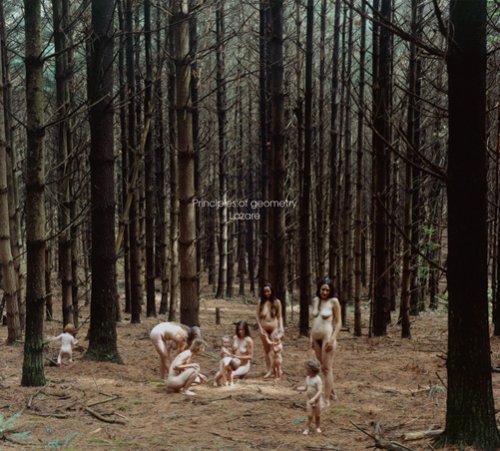
Principles of Geometry: Lazare


“Lazare” (Principles of Geometry)

Normally I wouldn’t just take to promoting electronic music that so flagrantly espouses the combination of nudity and polygamy in in a primeval environs, but for this set of glitch-influenced, hip-hop sprinkled, Boards of Canada-indebted (for cover art and in part for style) platter of unflinchingly digital oscillators with a taste of ye olde industrial gait, I will make an exception.

Exception made. Album recommended.

QA

Szigeti:

“So, do you write fact or fiction?”

Hrabal:

“Not fiction, more the truth. Mind you, everything is the truth.”

Things We Thought

Last night I sat at an age-appropriate bar drinking belgian stye triples until finally Paul Westerberg came on the stereo.

When you’ve been drinking and Paul Westerberg comes on this is really the only interpretation of reality that remains open. As your maudlin id gets bolder, the grandiose yearnings become more tangible, and you remember that you were once meant to be fantastic.

And that is when “We May Well be the Ones” starts playing.

Never mind the foolish, swollen hangovers that you know are sure to follow. In a small moment, pop works on you as an anaesthetic. You can commune with yourself the way the booze helps you talk to others, pulling away all topics of conversation and points of interest and narrowing the scope of discussion to a point, an algebraically symbolic point, at that. You have your little self-constructed buddhist trip, just you, your false ego, and Paul Westerberg, and you entertain yourself with the idea that you yearn to rise as the lotus, free of shit from the swamp.

Because you do still yearn to rise as the lotus, free of shit from the swamp.

Long Illusions

The question when you meet a new land and a new people is, “what is this new false mystery, what is this unique regional diversion standing in for the arrival at an inevitable conclusion, a conclusion that might once have come in an instant if we had never in the days of some golden pre-Chinese dream become dishonest with ourselves?”

We trade the soul-mason’s handshakes and banter encrypted verbiage and this way we tell ourselves that we know each other; we tell ourselves that we know ourselves and we know this other, but it nags that we may never have found ourselves foundering, self-induglent even when truly suffering, shored up in ignorant pastimes and stand-ins for answers we found it natural to seek in youth, in futile and elaborate ruses built of matter, flesh, time, questions, and the endless streamers of thought and altered thought interrupted by misfiled memory and haphazardly administered medicines streaming out as in a strong wind in all directions from the point we seem to occupy. It nags that we must ask, “what is this new false mystery,” as these streamers stream out and we circle inward, not ever really posing the question, married instead to the Buddhist algebra of compromise from which we build our weird semiotics.

My Music Picks for ’07

There is so much music out there in so many different genres with such an endless array of clandestine channels of distribution now. It’s distracting, and it can lead to the impression that it’s all sort of being averaged into this high-speed slurry of mediocrity. Music is folk again- the players are more ubiquitous, but the Shakespeares are still just as few. In the midst of all that music coming out that’s demanding an equal amount of your diminishing time and attention (that amount is 100%, if you weren’t aware) there are still gems. That said, this was still a weird year for music.

Forgive my imperfection- I am only human, and I can only develop a relationship with so many recordings in a year. In no particular order, the records I liked the most this year are:

Private Lives – Private Life (can still be bought as part of the Soul Jazz Records singles compilation.)

The machine cries for the loss of its diginity and humanity, and we get to dance to it.

Shellac


“Excellent Italian Greyhound” (Shellac)

Rock music consisting of only a few moving parts. Please watch your fingers.

Black Devil Disco Club


“28 After” (Black Devil Disco Club)

Spooky, nostalgic, and messy.

Radiohead


“In Rainbows” (Radiohead)

A driving disquiet.

The National


“Boxer” (The National)

A quieting angst.

LCD Soundsystem


“Sound of Silver” (LCD Soundsystem)

The kids seem to like it, but it’s still better than anything anyone else is doing.

Andrew Weatherall


“The Bullet Catcher’s Apprentice” (Andrew Weatherall)

Giorgio Moroder listening to Skinny Puppy.

Ted Leo & the Pharmacists


“Living with the Living” (Ted Leo and The Pharmacists)

Ted is a machine, a beautiful machine that only tells the truth.

Trans Am


“Sex Change” (Trans Am)

I think these guys riff in their sleep, like dogs run in theirs. There is no reason a band should be this good at playing their instruments.

Gone Glimmering

I had one of those moments of convergence, where disparate occurrences of information in life or memory are spontaneously united at an unanticipated confluence. Imagine being a Quebecois furrier in your squaw-‘n-victuals laden canoe paddling after your pelts down one watery byway or another, memories of a mythical and antedeluvian France reflected endlessly across the water and among the halls of your mind (a private, endlessly liquid Versailles), and somehow impossibly, rounding a copse of maple and a bend in a tributary you find you’ve followed an animist beaver down its hole, as it were, and sailed right out of Canada and onto the Seine. Two things, once separate but real, are now connected and mutually reinforcing.

The confluence:

NYC 90’s rock outfit Chavez, whose 2-album canon was recently re-released with reposado especial treatment by label Matador, called their screeching, angling, mathematical space rock album debut Gone Glimmering. I have to thank my friend Todd for being a longtime champion of this form and initially exposing me to Chavez in college- along with, in the years that have followed, bands like Hum, Shiner, Centaur, and recently Pinebender.

Scott Fitzgerald was a writer from St. Paul, Minnesota, that sure-footed metropolis on the Northern Mississippi that’s twin to the wider-avenued Minneapolis just across the river’s expanse. His themes of choice were the degenerate tendency of the rich of the gilded age and a fascination with the inherent difference in makeup between those nursed by leisure and those not so fortunate. His narrative voice was piercing, beautiful, philosophical and yet stiletto-concise, the fruit of the labor of hanging out of a window on the human soul and looking on and looking on, taking a therapist’s notes.

He wrote a short story called Absolution, in which a priest hearing a boy’s confession for having taken communion without first having had confession suddenly dies. The priest loses his grip on his senses:

For a moment longer the silence persisted while rudolph waited, and the priest struggled to remember something that was slipping farther and farther away from him, and the clock ticked in the broken house. Then Father Schwartz stared hard at the little boy and remarked in a peculiar voice:

“When a lot of people get together in the best places, things go glimmering.”

Rudolph started and looked quickly at Father Schwartz’s face.

“I said-” began the priest, and paused, listening. “Do you hear the hammer and the clock ticking and the bees? Well, that’s no good. The thing is to have a lot of people in the centre of the world, wherever that happens to be. Then” – His eyes widened knowingly – “Things go glimmering.”

…

“This man is crazy,” he thought, “And I’m scared of him. He wants me to help him out in some way, and I don’t want to.”

“You look as though things went glimmering,” cried Father Schwartz wildly. “Did you ever go to a party?”

“Yes, Father.”

“And did you notice that everyone was properly dressed? That’s what I mean. Just as you went into the party there was a moment when everyone was properly dressed.”

…”My theory is that when a lot of people get together in the best places things go glimmering all the time.”

…

“Please listen to me!” Commanded the priest impatiently. “Stop worrying about last Saturday. Apostasy implies an absolute damnation only on the supposition of a previous perfect faith. Does that fix it?”

…

“Look here-” He came nearer to Rudolph, but the boy drew away, so Father Schwartz went back and sat down in his chair, his eyes dried out and hot. “Did you ever see an amusement park?”

“No, Father.”

“Well, go and see an amusement park. It’s a thing like a fair, only much more glittering. Go to one at night and stand a little way off from it in a dark place – under dark trees. You’ll see a wheel made of lights turning in the air, and a long slide shooting boats down into the water. A band playing somewhere, and a smell of peanuts – and everything will twinkle. But it won’t remind you of anything, you see. It will just hang out there in the night like a colored balloon- like a big yellow lantern on a pole.”

Father Schwartz frowned as he suddenly thought of something.

“But don’t get up close,” He warned Rudolph, “Because if you do you’ll only feel the heat and the sweat and the life.”

So, there was my confluence- a hanging question of a hitherto unexplained album title and the sudden emergence of that strange phrase in a short story.