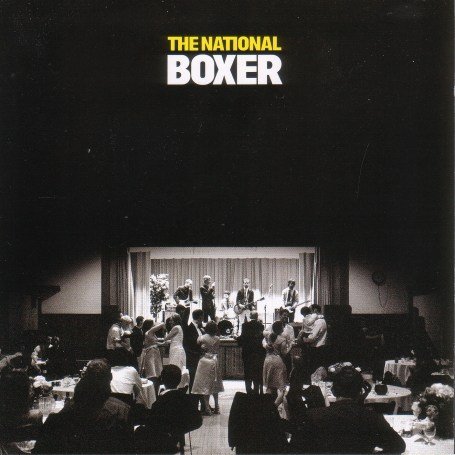
The National: Boxer

Beggars Banquet 5/22/07

Part of the experience of becoming attached to an album is that surprising moment when it comes at you out of left field, when something doesn’t go quite as you’d expect.  A good album gets behind your defenses and bypasses your algorithms of expectation.  It makes you set new frames of reference and reconsider what you thought you ought to expect.

The inwardly-gazing bent of The National’s brooding humanity of subject matter and intermittently bombastic catharsis did just that on Alligator, their last album.  The deep, woodgrain timbre of Matt Berninger’s vocals chanting the stream of everyman’s consciousness brought the poetry of music for mass consumption into new, more personal spaces.  In between nervous breakdowns, oddly-timed just as they are in life, the songs on that album taught the listener to wait and listen to learn how they meant, not just what they meant or how they sounded.  Alligator was The National’s beautiful album of pop music without a user’s manual.  With no one to ask how to hear it, you had to wait until the wash of sound and verses found a chink in your understanding and flushed in.

The personal settings and themes of the songs on Boxer, the new album, are not new ground for the band, but their delivery is.  The songs are less accusatory.  They are more often simply in the space they describe, at home with the facts they lay out, such as when Berninger intones on Slow Show “I want to hurry home to you/put on a slow, dumb show for you/crack you up/So you can/Pin a blue ribbon on my breast/but I’m very, very frightened/I’ll overdo it.”  We see vulnerability and the admission that to return home to the fake empire of interpersonal myths, like returning to Vonnegut’s all-important “nation of two”, to return to the myths that stand to privately glue people together, is the paramount desire.  The concerns the songs are focused on are not with the world at large, but, as with the first single, Mistaken for Strangers, whether the play-acting and personal mythbuilding we all engage in severs or strengthens the ties we keep dear between each other.

On Boxer, there is an audible lack of those screaming outbursts that lent their urgency to standout tracks Abel and Lit Up on the previous record.  There are no longer the bewildered pleadings and apologies of tracks like Alligator’s Baby, We’ll Be Fine or Friend of Mine.  Instead there is a tangible, studied space and pacing to the record.  I said it before, but singer Matt Berninger’s voice is woodgrain, it is a part of the music that surrounds it.  It ages, changes colors.  It becomes better and more careworn the more time the listener spends with it.  The subtlety of the production, the absolutely perfect timing of each instrument, the whisper of backup vocals at the decided-upon moment; touches like these, and touches like the mechanical puff of pink noise peeking like Kilroy over the percussion on Apartment Song— each of these things bespeaks a flagellant’s devotion to presentation, a maniacal drive and fury behind the scenes.  There, behind the bluescreen, is where the twitch and ire worn on Alligator’s sleeve has holed up, dug foxholes, dedicated pillboxes whose cornerstones no one but moles will read where devotees of a long and meaningful moment, devotees of our episodic and continuous human lives, will drink black coffee and pore over maps and strategy in fevered isolation.

To conclude, it is fitting to quote from a poet Berninger’s lyrics’ imagery quite often evokes, Robert Lowell.  In Thoreau II, Lowell writes, ‘…For Thoreau/Life in us was like water in a river: “It may rise higher this year than all others.”/Adrift there, dragging forty feet of line,/he felt a dull, uncertain, blundering purpose…’

This reviewer is reminded of the scene in The Outlaw Josie Wales wherein Clint Eastwood shoots the ferry rope of the raft carrying his pursuers, capsizing the craft and buying him time to escape.  Squinting into the sight of his rifle he prefaces the shot by telling the carpetbagger who had moments before crossed the river with him, “Out here we got a thing we call a Missouri boat ride.”  To really listen to The National is to admit that you can relate to the foundering Missouri boat ride we drift on with friends, family and lovers, dragging forty feet of line and feeling a dull, uncertain, blundering purpose on our pull from one bank of life’s flood to the next.
Everything was Beautiful and Nothing Hurt OR God Bless You, Mr. Vonnegut

Kurt Vonnegut, Jr. died this past week, but it is not true to say that we suffered a terrible loss with his passing.

There can be no question that his passing will be noted. If not all of us collectively, I, at least, will certainly miss him. But Mr. Vonnegut described to us throughout his life the one true, terrible loss we all suffer without exception. His work was an obituary he wrote to us over and over to remind us of a thing that was already gone, but one that he exhorted us to become aware of. His reminders were intended to move us, finally, to take the steps in our power to gain that thing back.

Our true loss is our discarded humanity. It is our shared international cultural goal to slip out of the bonds of kindness, rationality, and responsibility to one another faster than the next human in the race. In short, our terrible loss is our missed chance to be good.

We should be bereaved to see our curmudgeonly kind man of letters pass. He treated us as a friend, and we need as many of those as we can get. But do not take off the black crepe when the customary time for mourning a man and a friend has elapsed. Mourn then that in his stead among men of letters in our day there are few but dandies. Mourn then that among men of peace there are few with influence. Mourn then that, because of this, once our selfishness has seen to it that we’ve used up the means to support everything we’ve become, once we’ve surpassed our capabilities to replenish all the clever devices that support who we are, and once our balance of mutual enmity passes into a permanent and irreconcilable surplus- our computers, our stereos, our printing presses, our guitar amplifiers, our televisions, our automobiles, our trains, our refrigerators, our airplanes, our libraries, our roads, our post offices, our museums, our clean water, our food, our stories, our poetry, our art, our love, our families, our cultures, our cities, our civilisation- all of this, even the letters that make up the words you’re reading now, will probably be irretrievably lost.

And then, Goddamnit, stop mourning. Be different. Be kind. Be good. We don’t have any more time to waste.

Thank you, Mr. Vonnegut! Would that you could have said at the end, “Everything was beautiful and nothing hurt.” Would that it might one day be true.

April 18, 2007
New York

Everything was Beautiful and Nothing Hurt OR God Bless You, Mr. Vonnegut

Kurt Vonnegut, Jr. died this past week, but it is not true to say that we suffered a terrible loss with his passing.

There can be no question that his passing will be noted. If not all of us collectively, I, at least, will certainly miss him. But Mr. Vonnegut described to us throughout his life the one true, terrible loss we all suffer without exception. His work was an obituary he wrote to us over and over to remind us of a thing that was already gone, but one that he exhorted us to become aware of. His reminders were intended to move us, finally, to take the steps in our power to gain that thing back.

Our true loss is our discarded humanity. It is our shared international cultural goal to slip out of the bonds of kindness, rationality, and responsibility to one another faster than the next human in the race. In short, our terrible loss is our missed chance to be good.

We should be bereaved to see our curmudgeonly kind man of letters pass. He treated us as a friend, and we need as many of those as we can get. But do not take off the black crepe when the customary time for mourning a man and a friend has elapsed. Mourn then that in his stead among men of letters in our day there are few but dandies. Mourn then that among men of peace there are few with influence. Mourn then that, because of this, once our selfishness has seen to it that we’ve used up the means to support everything we’ve become, once we’ve surpassed our capabilities to replenish all the clever devices that support who we are, and once our balance of mutual enmity passes into a permanent and irreconcilable surplus- our computers, our stereos, our printing presses, our guitar amplifiers, our televisions, our automobiles, our trains, our refrigerators, our airplanes, our libraries, our roads, our post offices, our museums, our clean water, our food, our stories, our poetry, our art, our love, our families, our cultures, our cities, our civilisation- all of this, even the letters that make up the words you’re reading now, will probably be irretrievably lost.

And then, Goddamnit, stop mourning. Be different. Be kind. Be good. We don’t have any more time to waste.

Thank you, Mr. Vonnegut! Would that you could have said at the end, “Everything was beautiful and nothing hurt.” Would that it might one day be true.

April 18, 2007
New York

Everything Was Beautiful and Nothing Hurt.


Hi-ho.

We knew a time like this would come to pass. It wasn’t the likes of Kurt Vonnegut, Jr. who left us with our contemporary literary dandies in lieu of Voices. That is a parting gift we have left ourselves.

It is late now to remember to thank you, but thank you, Mr. Vonnegut.

Mornings and Churches

The sky here in Manhattan has that blue-r than blue island quality to it this morning, and my walk home brought me past some archival footage of churches.

This photo was taken with my lovely phone.

Apologies for crookedness.

The Ghosts of Loves Unfinished

“Know this thing for certain,” these the first words he forms in his mind as though they could be spoken when he wakes in the dark, though he does not actually speak, “Dreams will always betray you and how you think things are going.”

When for weeks life was workaday, now those things whose constance was assured and assented to have been summarily brought back under review by the subconscious committee and rejected for fitness in one decisive motion.  In a meeting held as he slept, no less.

His compromise with life is to operate on scale.  His new job could be worse than it is.  The fact that it is better than his last job gives him a solace that will, for a time, function in lieu of success.  His wife is loyal and loves him honestly.  When he imagines his wife’s love and the love of the woman he had let come before as neutral red foam bars rising up from the ground beside each other as though they are part of a bar graph quantifying and comparing the two varieties of intimacy and relationship, the sum total of his wife’s kindness and honesty stands very noticeably taller than hers, the one he had committed to before,  she who was brilliant but prone to boredom, who had been very adept at digging him hollow like a native’s canoe when his jokes and drinking were no longer funny and paddling him ably up shit creek.

Dreams will not re-read the pages of chapters written to their finish and ask what might have been.  Here the length and breadth of the betrayal of a dream is limited to wistful remembering, a fresh taste of the variety of loneliness that that one left you with unameliorated by time or rationalization.  The worst these dreams can do is sit on your chest like a succubus until you’ve shaken their weight off.  But that weight will always come off.  Demons you have exorcised will drop in for tea now and again, after all, but abide by a politeness not observed in that first breaking and entering.

When dreams team with the phantasms of loves that end by no impetus more robust than circumstance, however, there is the formula that dissolves the palliatives binding prosaic life like an enzyme, a perfect equation suited to the task of digesting the patchwork of acceptance of the way things have become until it appears ragged as resignation.

The dream brought her to him again, she whom he had been happy enough to see off, in whose bon voyage he carried little enough outward culpability, in the acceptance of whose departure he bowed to finance and a nascent career he wasn’t particularly interested in.  She, too, young as she was, shrugged off the blow, apparently.

“I’ll never know.” he speaks aloud this time, lying on his back.

Greater than the hunger that is now awakening in his belly, and harsher than the weird lack of the caffeine his waking mind is beginning to crave, he feels the want to stop the feeling that he’s been absolutely thorough in his life only in the pursuit of the wrong thing.

Almost all of his regrets begin with ellipses:

…and that’s why I have to go to work in an office every day.
…and that’s why I’ve never been published.
…and that’s why I’m not free now to do what I want.

Only one of them, this morning, begins with gold blonde hair and eyes as big and blue and portending of a coming lack as they were once present and tangible in one summer in his life.  Only one of them makes him crave to hear French spoken to him early in the morning as he heard again as he was sleeping that night.

“J’embrasse, mon petit coeur.”

Technorati Tags:

Murakami Magically Comes Around


I’ve said before that I could never tell if Murakami, with all his meticulously cataloged insight into people, was just fucking with us as he wrote each of his dull and unflinching, non-plussed heroes into some diamond-studded corner of miracles to let amazing experiences wash over them without blessing them with a single iota of an outlook-bending epiphany of self-awareness before eventually killing them. My struggle with Murakami has always been over that: Does he champion an insidious point, or is he winking and laughing as he plays the infidel, dishing up his perfectly socialized characters inured to their impossible fates by boredom in order to injure our own sense of order? Is the meat of his insight served not from the charming, off-beat magic of his fantasy worlds, but instead from the infuriating repetition of menu items, sandwich contents, beverage counts, technical recountings of deeds done and only thought about as weird fate closes in on a character not so much hapless, but wholly unmotivated to question or attempt to thwart his or her own end?

Well, I had given Murkami up for a fantastic nihilist, one whose charming descriptions of horrible fates wholly unavoided in some way advocated complacency. That was the conclusion I had come to even though it was thinking on his books that first brought to my mind the concept of didactic wrongdoing.

I’m still not sure exactly where he stands, but I am about 14 chapters into Kafka on the Shore now, and he’s addressed this question more or less head-on. The main character, Kafka Tamura, is discussing his opinion of Soseki Natsume’s The Miner. In discussion of the hero of that novel, Tamura complains that “…eventually, he gets out and goes back to his old life… But nothing in the novel shows he learned anything from these experiences, that his life changed, that he thought deeply now about the meaning of life or started questioning society or anything… He’s totally passive. But I think in real life people are like that.”

Aha! Murakami is, at least in some sense, aware of what he is doing! But, the second person in that conversation retorts with:

“But people need to cling to something… it’s like Goethe said: Everything’s a metaphor.”

So which one is Murakami? Is he directly confronting critics like me here and then offering a one-liner pithy rejoinder for how his characters can remain so broken-spirited and Japanese to the end, come what may: talking cats, mad science, or sado-masochism? Or perhaps the metaphor as transparent as that: this character whose lack of ambition is so grating is YOU, social man, and the story I’m telling is supposed to feel wrong. Didactic wrongdoing is such a stretch, though, and it smacks of naive hero-worship of the author who brought me Pinball, 1973 and Norwegian Wood. Murakami could just as easily be as gifted and equally stunted by the violence of his socialization as Dostoevsky, another unflinching diarist of the human soul.

In any event, my curiosity is piqued.