
I don’t think I own another record more complexly committed to archival matter than Kahimi Karie’s K.K.K.K.K.K.K.
I don’t think I own another record more complexly committed to archival matter than Kahimi Karie’s K.K.K.K.K.K.K.
 In the recent batch of CDs I picked up at my local Virgin Megastore was A Bestiary of by the Creatures, a compilation of Robert Smith contemporaries the Creatures’ early catalog of the Wild Things EP from ’81, the Feast LP from ’83, and the and Miss the Girl and Right Now/Weathercade singles from ’83.
The Creatures are Siouxsie Sioux of Siouxsie and the Banshees and Banshees drummer, Budgie. Comprised thus of only rhythm and vox, this disc is an exploration of the textures evoked by layering complicated percussive patterns, spectral pads, cross-cultural/multi-lingual vocal samples, and Siousie’s dirging… (Ok, I’m picturing Futurama’s Zap Branigan saying this) …eroticism. Listening through to the end of the disc yields the bonus of the final track, Right Now, a surprise horn-adorned jog into sexual immediacy’s gape that, despite the horn line, still seems to rely more on vocal texture and drums than anything else to move the song along.
Now, how to describe all this without using all the same stock phrases that all goth reviews have used usque ad nauseum to express just how Siouxsie’s choice of phrase and her unmistakable inflection (interspersed with assorted moans and sundry impassioned escaped utterings) combine to impart the certainty of a dire last chance irrespective of her subject matter?
This is a great disc, holding the attention with spare arrangements and experimental instrumentation and Siouxsie’s timelessly terrible (in the old-testament sense) sex, a taste nailed on the tongue as she tickles the ears.
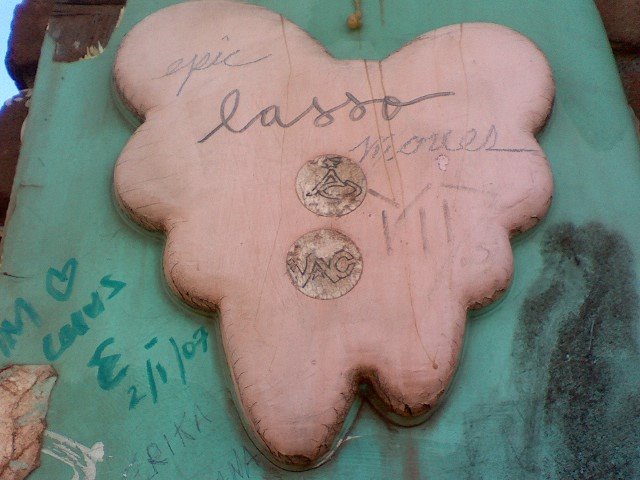
ignored monument to love, 14th st. and 1st ave, 50 degrees, clear skies and sunny.

As mentioned in the previous post, I picked up Trans Am’s new disc the other day. What I like about Trans Am is that even what is apparently simple about their sound is, to the ear, beyond exacting. Trans Am are post-rock wank wunderkinder. They are a band that is just as likely to wow you with the tightness, subtletly, and complexity of their riffs as use their considerable talents for playing their instruments and manipulating the recording process to fuck with you as they explore an exaggerated iteration of some tangent of rock that has been fascinating them. Trans Am is on a two-record hot streak of solid playability. You cue Sex Change in your media util and there is no need to touch, shuffle, skip ahead, or in any other way molest the cool, reptilian confidence of the recording’s progress from frame 00:00:00 to finish. Unlike Thrilljockey labelmates and fellow post-rock accused Tortoise or The Sea and Cake, Trans Am has always kept a strongly symmetrical and Krauty backbone to their rhythm section, along with an allegiance to eerie, aetherial synthesizers. The result is that, instead of producing rock music with the mutant shuffle of math and jazz flourishes, Trans Am assembles rhythmic rock songs of a length unoffensive to the pop-trained attention span, but with all the flourish, artistry, obvious skill, and penchant for oscillation between compatible time signatures and heretofore incompatible styles of instrumentation (distorted Vs. clean guitar, et & c.) of prog. Oh, and sometimes they chill you cold like Kraftwerk. The occasionally tongue-in-cheekiness of the lyrics is interestingly backdropped by the evident effort put into their elaborate instrumentation. Their wank is uncluttered and expansive on Sex Change. Particularly noticeable on this release is their development of their surgical metal guitar and their eerie, 70’s prog church choruses. Standout track “Shining Path” grinds from start to finish through an aural world of driving light. Final track “Triangular Pyramid” sounds like it must feel to be thrown, as a titan, upon the merciless crags of some ancient mountain range as gold light pours from your god’s wounds.
These guys know their shit and they know how to make a great album. Also check out Futureworld, Surrender to the Night, and the amazing paranoia-fest Liberation.
Ah, router troubles have ended. The long, local freakout appears to be ended. I picked up a few albums in recent days:
Mythmaker:Skinny Puppy
A Bestiary of:The Creatures
Sex Change:Trans Am
Telekon:Gary Numan
Reviews to follow. I feel like I’ve been cooped up in a box the size of a peanut. My mind is the magazine, my mouth is the AK- watch me spray. Ya’ll.
I’m a little late getting to the criticism of the recent auto manufacturer advertisement featuring an assembly line robot being fired. The critical party has already kicked off with a fervor that has apparently produced results, but I’m still going to weigh in with my two cents. The argument and the results that it achieved were neither the argument that needed to be raised as a result of the commercials, nor were the results that were achieved appropriate.
The furor that was portrayed as erupting in the popular media over the recent ads, these ads having been first unveiled during one of the many big games of one of the many incarnations of the (!Sports Bowl!), were raised by an organization for the prevention of suicide whose charter includes, not surprisingly, raising awareness of and increasing prevention of suicide. Their primary beef with the ad in question is that in the course of the advertisement’s short storyline, a redundant robot, unable to find fulfilling or fitting gainful employment following getting the pink slip for workplace incompetence, throws itself off a bridge, kissing all prospects a wistful goodbye in the hopes of a shameless oblivion.
The offended organization objected to the ad based on the portrayal of suicide. The auto manufacturer made an amendment to the end of the ad in question in response, removing the automaton’s final act of surrender from the short story arc of the commercial spot’s montage.
In the new version of the commercial, the robot does not “kill himself”, but the overarching message of the commercial’s plot remains intact. That is the insidious thing.
The commercial’s portrayal of a robot being fired from its assembly line job for a single act of incompetence most willfully calls to mind the original automation of operations this conglomerate of conveyance manufacturers’ undertook- the push for automation that vaporized Flint, Michigan, the story of which is recounted in filmmaker Michael Moore’s breakthrough documentary, Roger & Me.
In the commercial, human and robot coworkers alike, apparently working in a peaceful and accepting harmony, look on sorrowfully as the management types eject the robot from employment for dropping a screw. This creates the first false impression of the ad, the impression that humans and robots on the assembly line are equals and can and do recognize each other as such, in spite of the acrimonious history between workers and management over the introduction of automated labor devices to the factory setting.
Workers and robots are not on an equal footing. For one, robots are obviously not human. They do not have human needs such as the need to eat or the need to support a family. They do, however, displace workers who, for a few generations were brought up solely to work in the plants of the auto manufacturers.
The second false impression created by the commercial is the apparent legitimization of the company’s hiring and firing practices. In the commercial, the management is seen to be fair, in that it runs its business according to the same middle class values as its human workers- when someone is incompetent, they are not allowed to ascend to the acme of success, but are instead penalized with redundancy. However, can it be said that this company’s drive toward profit for a few, one that cost so many livelihoods, was legitimate in its execution? Can it be said that the automation of the assembly lines and the ensuing loss of jobs was predicated on the same values as the middle class laborers whose lives were altered?
The third false impression perpetuated by the commercial is that the replacement of the workers and the atomization of the community the company supported, apparently undertaken under the directives of middle class values, was legitimate intrinsically, and not undertaken irresponsibly because automation was based on rags-to-riches, hard work will get you everywhere middle class values.
Overall, the commercial also serves to trivialize the induced sublimation of Michigan’s prospects from stuff to vapor in its portrayal of human workers comfortably working alongside their replacements as though it is a natural state of things that has always been accepted. One of the very gripes brought up in Michael Moore’s documentary Roger & Me was that this manufacturer attempted to herald its commitment to progress once before with an Epcot-like display of humans and robots working happily side by side singing some song about, essentially, moving forward at the cost of the human laborers’ own displacement. In poor taste then, and no less so now, It’s obviously not something that the company has put to bed as far as talking points and the influence of public opinion are concerned.
Robots cannot kill themselves. To suggest that they can and that it is funny is to mock the plight of the mob of unemployed laborers this company created. Robots would never feel pressed to review that as an option, unlike the laborers their implementation displaced.


San Fran in the morning.

Tata Steel, as mentioned in the article the fellows from New York Reggae band Steel Pulse will link you on your mellow way to, has acquired Corus Steel. No word on whether the Tatas will seek to acquire New York Reggae band Steel Pulse, but it is a sure bet that members of New York Reggae band Steel Pulse would like to acquire some tatas. Am I right, fellas? Am I right?

pete's place

